Solid-state fermentation: growing microbes on moist solids
Most people picture industrial microbiology as steel tanks full of stirred broth. A quieter, older tradition grows microbes on something much closer to their natural home: a damp heap of bran, husk or grain with no free-flowing water at all.
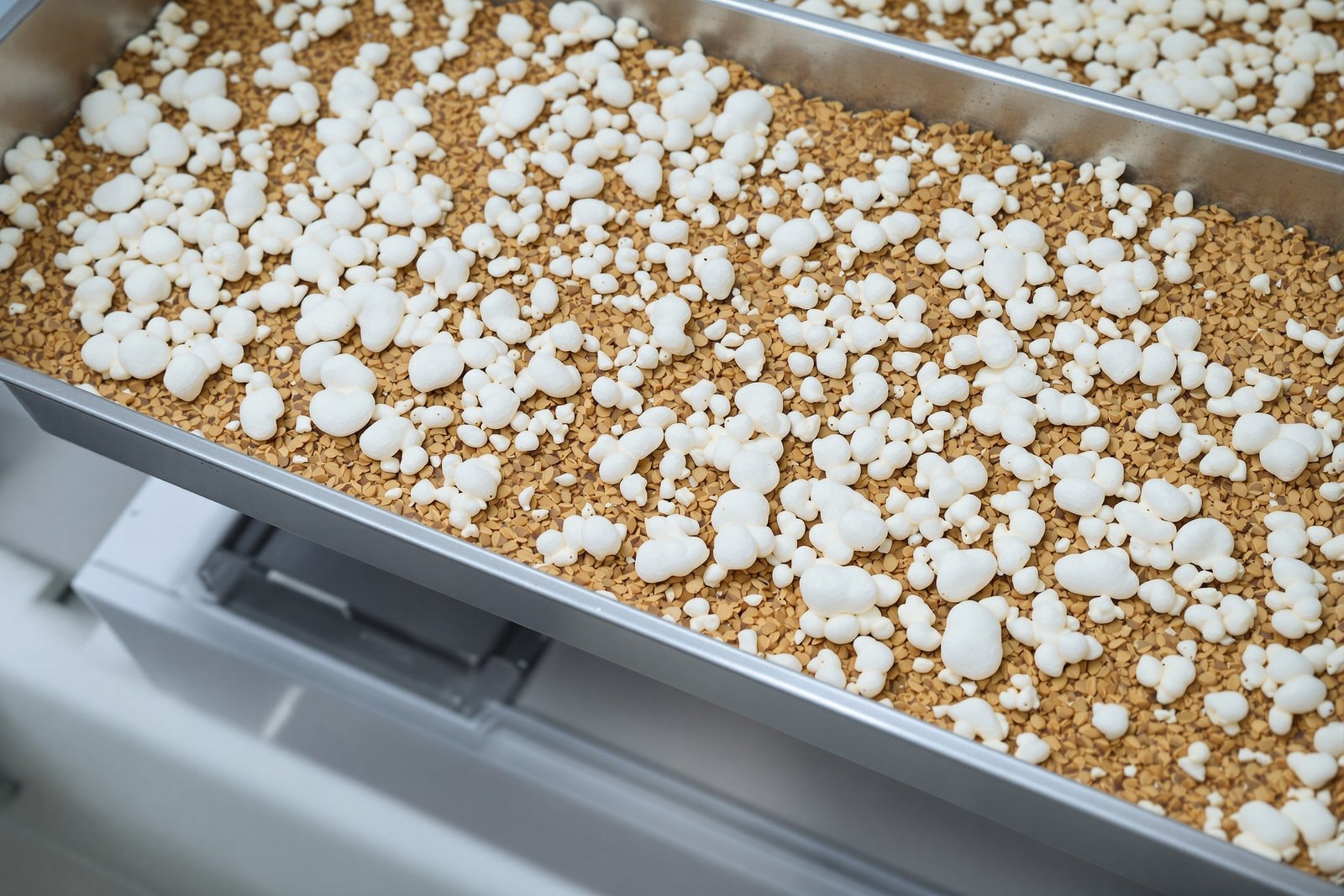
What the term means
Solid-state fermentation, usually shortened to SSF, is the cultivation of microorganisms on a moist solid support rather than in a liquid. Wikipedia's article on solid-state fermentation describes it as a manufacturing process used in the food, pharmaceutical, cosmetic, fuel and textile industries, in which the products are mostly metabolites made by microorganisms grown on a solid support chosen for the purpose. The same article presents it as an alternative to liquid, or submerged, fermentation, which dominates industrial practice.
The picture it gives of the process is homely. A solid substrate such as rice or wheat bran is spread on flat beds after being seeded with the chosen organism, and the beds are then left in a temperature-controlled room for several days. There is water in the system, but it is held in and around the particles rather than pooled between them. That single difference, water bound to a solid instead of a solid suspended in water, shapes almost everything else about the technique.
Why fungi prefer it
Liquid culture suits single-celled organisms such as bacteria and yeasts. Filamentous fungi are another matter. As the Wikipedia article explains, a fungus growing in liquid spreads as a network of hyphae that thickens the broth, reduces how much oxygen can dissolve in it, and is torn apart by the stirring needed to keep it aerated. On a solid surface the same fungus behaves as it would in soil or leaf litter, spreading its mycelium across and between particles with air all around it. For moulds that naturally live by breaking down plant material, a bed of bran is simply a more familiar world than a tank.
The fungus does not eat the bran as it finds it. Much of a plant residue is insoluble, so the organism secretes enzymes that cut large molecules into smaller soluble ones, such as sugars and amino acids, which it can absorb. The article notes that the composition of the substrate influences which enzymes the fungus expresses and in what amounts. That is the commercial point of the whole exercise: choose the substrate and the organism well, and the solid bed becomes a place where useful enzymes accumulate.
Farm residues as raw material
Many of the substrates used in SSF are by-products of agriculture and food processing: brans, husks, straws, pulps and cakes left over after oil extraction. They are cheap, abundant and already shaped by nature to feed the fungi that break them down. Wikipedia's article records the economic argument often made for the method: compared with submerged processes, SSF needs smaller vessels, uses less water, produces less wastewater to treat and consumes less energy.
A widely cited 2005 overview in Critical Reviews in Biotechnology by Krishna surveys the field from its history onward. According to its abstract, the review covers the factors that affect SSF, among them inoculum type, moisture and water activity, pH, temperature, substrate, particle size, aeration and agitation, and oxygen and carbon dioxide, and it describes the different kinds of fermenters used. It also discusses the economic feasibility of using SSF to make industrial enzymes and argues for wider use of the approach in the biological detoxification of agro-industrial residues and in bioremediation.
Enzymes made on solids
Enzymes are the best-known products of SSF, and they sit inside a much larger industry. Wikipedia's article on industrial enzymes describes them as enzymes used commercially across pharmaceuticals, chemical production, biofuels, food and beverage and consumer products, and notes that their appeal lies partly in working under mild conditions with a precision that conventional chemistry often lacks.
Two enzyme families come up again and again in SSF work. The first is the amylases. Wikipedia's article on amylase defines it as an enzyme that breaks starch down into sugars and notes that, besides animals, plants and some bacteria also produce it. Starch-rich residues are natural substrates for organisms that make these enzymes. The second is the xylanases. Wikipedia's article on xylanase explains that these enzymes degrade xylan, a component of the hemicellulose in plant cell walls, that the principal commercial source is filamentous fungi, and that commercial applications include the chlorine-free bleaching of wood pulp before papermaking. Proteases, which cut proteins, are a third group often studied in the same way.
What makes it hard
SSF has its own difficulties, and they are mostly about heat, water and uniformity. A bed of growing fungus produces heat, and a solid conducts it away poorly, so the middle of a deep bed can warm up far more than its edges. Moisture drifts as the culture grows and as air moves through it. Sampling is awkward, because there is no single well-mixed liquid to draw from, and measuring how much organism is present is harder when it has grown into the substrate itself. These are the reasons the literature spends so much time on bed depth, particle size, aeration and fermenter design, and why the method, for all its long history in traditional foods, is still an active research subject.
Reading about SSF
A reader meeting SSF in the literature will find the same variables named over and over: the organism, the substrate, the moisture level, the temperature and the length of the run, together with some measure of how much product was made. Comparisons between studies are difficult because small changes in any of these can matter. It helps to read a methods section with a simple question in mind: what exactly was the organism growing on, and how wet was it?