Telling male from female papaya seedlings
A papaya seedling gives no outward sign of what kind of plant it will become. Some will bear fruit, some will not, and a grower may not find out for months. DNA tests offer a way to tell them apart while they are still small.
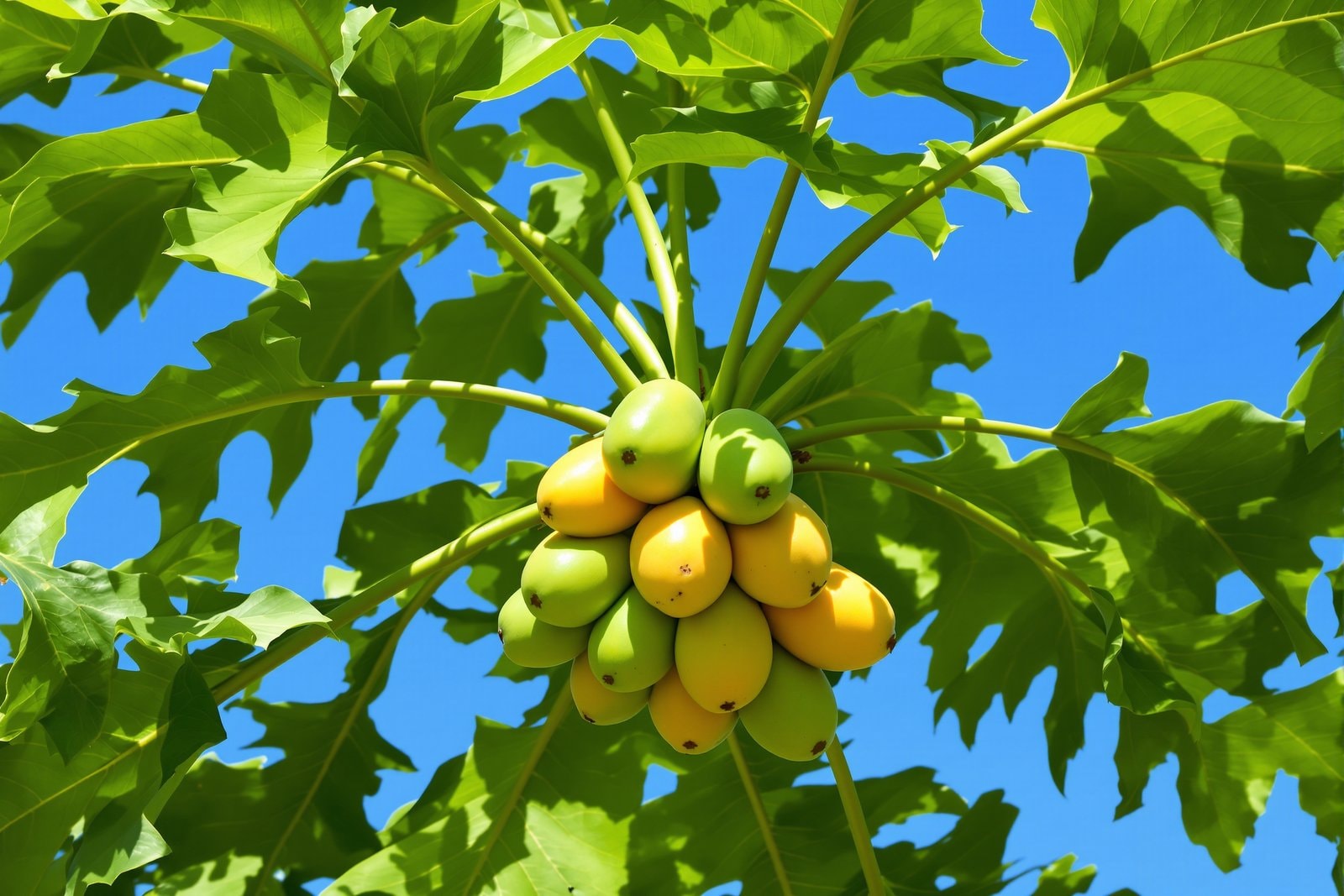
The papaya plant
Wikipedia's article on the papaya describes it as the plant species Carica papaya, first domesticated in Mesoamerica, within what is now southern Mexico and Central America, and now grown in many countries with a tropical climate. It is a large herbaceous plant with a crown of large leaves, and its fruit hangs in a cluster below them.
What makes papaya unusual among fruit crops is its sexual system. The same article explains that papaya plants grow in three sexes: male, female and hermaphrodite. The male produces only pollen, never fruit. The female produces small, inedible fruits unless pollinated. The hermaphrodite can pollinate itself, because its flowers contain both male and female parts. The article notes that almost all commercial papaya orchards contain only hermaphrodites.
Why growers care
A 2023 review in Plant Science by Ávila-Hernández and colleagues explains the grower's problem clearly. Its abstract states that sex determination is a principal challenge in papaya cultivation, because the flowers can bear three sex forms, male, female and hermaphrodite, and this affects fruit production, shape and yield. It notes that consumers prefer fruit from hermaphrodite plants to fruit from female ones, and that male plants rarely produce fruit and have no commercial value.
The trouble is timing. Papaya is raised from seed, and seedlings cannot be sexed by eye until they flower, months after planting. A grower who wants an orchard of hermaphrodites has traditionally had to plant several seedlings in each spot, wait for flowering, and then remove the unwanted ones. That wastes space, water, fertiliser and labour on plants that will be thrown away, and it delays the uniform planting that commercial growers want.
How sex is decided
The review by Ávila-Hernández and colleagues states that chromosomes are responsible for sex determination in papaya, denoted XY for male, XX for female and XYh for hermaphrodite. It adds an important caveat: genes related to sex have been reported but are not conclusive, and factors such as environment, hormones and genetic and epigenetic background can also affect how sex is expressed. The review discusses recent research on the reported genes, their biology, and approaches to sexing plants with molecular markers and their advantages.
Markers and PCR
If males, females and hermaphrodites differ at the DNA level, a small sample of leaf from a seedling should be enough to tell them apart. That is the idea behind molecular sexing. Wikipedia's article on the molecular marker explains that in genetics a molecular marker is a fragment of DNA associated with a certain location in the genome, and that such markers are used in molecular biology and biotechnology to identify a particular sequence of DNA in a pool of unknown DNA. A marker that sits in or near the region that differs between the sexes can act as a label for them.
Most marker tests rely on the polymerase chain reaction. The NIH Talking Glossary of Genomic and Genetic Terms, in its entry on PCR describes it as a laboratory technique for rapidly producing millions to billions of copies of a specific segment of DNA, using short synthetic DNA fragments called primers to select the segment and then multiple rounds of DNA synthesis to amplify it. In a sexing test, primers are chosen so that a particular DNA fragment is copied only, or differently, in plants of a given sex. The copies are then made visible, and the pattern shows which plants are which.
The Wikipedia article on markers notes that there are many types, each with particular limitations and strengths, and that some kinds, such as the random amplified markers known as RAPDs, are dominant and can be sensitive to the conditions under which they are run. For that reason, a band first found with a quick, general method is often converted into a more specific test that is easier to repeat reliably in other laboratories.
What an early test changes
A reliable seedling test lets a nursery plant only the plants it wants, one per spot, from the start. It does not change the biology of the crop, and the review's caveat about environment and other influences means that no test is likely to be perfect. When reading sexing studies, it is worth noting how many plants were tested, whether the result was confirmed by later flowering, and whether the marker was checked across more than one variety.