Sterilising culture media: autoclaves, microwaves and other methods
A culture medium is a banquet laid out for microbes, and it cannot tell the invited guest from the gatecrasher. Before any organism can be studied on its own, the medium it grows on has to be made completely free of every other living thing.
Why media must be sterile
Wikipedia's article on the growth medium describes a medium as a solid, liquid or semi-solid designed to support the growth of microorganisms or cells, and explains that the most common media for microorganisms are nutrient broths and agar plates, with liquid media often mixed with agar and poured into Petri dishes to set. Such a medium, rich in nutrients, will support almost any microbe that lands in it. Spores drift in air and settle on every surface, so an untreated medium left for a day or two will usually grow a mixed crowd of bacteria and moulds.
That is fatal to most experiments. A researcher studying a particular strain needs to know that whatever grows came from the inoculum and nothing else. The same applies to plant tissue culture, where a single fungal spore can overrun a jar of plantlets, and to the large vessels used to grow cells for protein production, where contamination can waste an entire run. Sterility is not an optional refinement; it is the precondition of the work.
What sterilisation means
Wikipedia's article on sterilisation in microbiology defines it as any process that removes, kills or deactivates all forms of life present in a fluid or on a surface or object. It lists the main means as heat, chemicals, irradiation, high pressure and filtration, and draws a distinction worth remembering: sterilisation is different from disinfection, sanitisation and pasteurisation, which reduce rather than eliminate the living things present. After sterilisation, an item is described as sterile or aseptic.
How an autoclave works
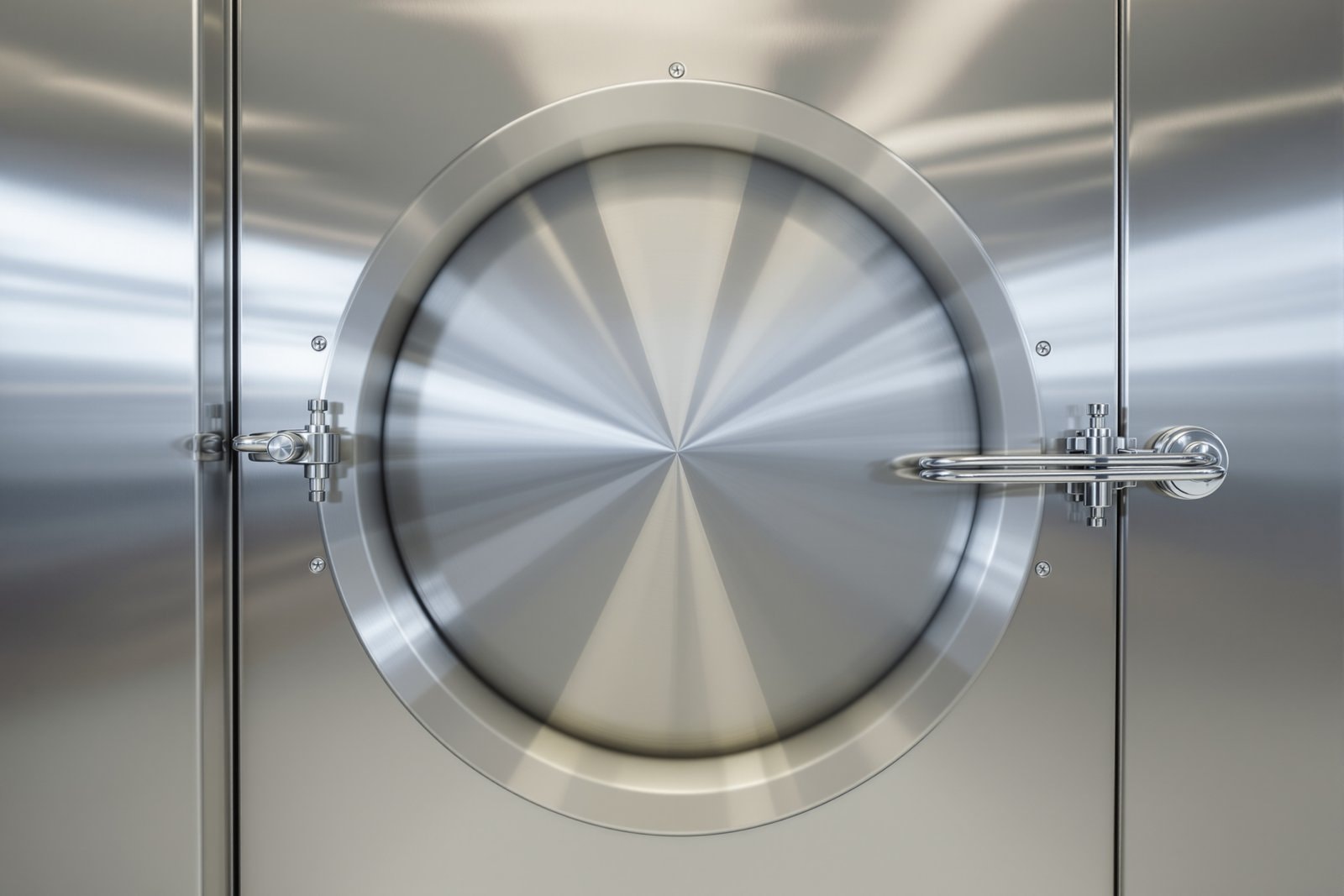
For culture media, the usual tool is the autoclave. Wikipedia's article on the autoclave describes it as a machine for processes that need temperature and pressure above ambient levels, found in medical settings, laboratories and other places that must ensure sterility. It notes that the autoclave was invented by Charles Chamberland in 1879, and that all autoclaves operate on the same fundamental principles as a kitchen pressure cooker.
The principle is that raising the pressure lets water stay liquid, and steam stay saturated, at temperatures well above its normal boiling point. The sterilisation article explains that steam sterilisation, also called moist heat sterilisation, uses heated saturated steam under pressure to kill or inactivate microorganisms by denaturing their large molecules, primarily proteins, and that it is faster than dry heat. The autoclave article stresses that all trapped air must be removed from the load before the cycle begins, because trapped air is a very poor medium for achieving sterility, and that items should be separated so that steam can penetrate the load evenly. It adds that some heat-sensitive materials, such as some plastics, cannot be treated this way.
Other methods
Not everything can go into an autoclave. Some ingredients of culture media break down with heat, and so are sterilised separately and added afterwards. The sterilisation article describes several alternatives. Filtration passes a liquid through a filter with pores too small for microbes. Dry heat is used for glassware and metal that tolerate it. Irradiation is used industrially for many single-use items. Chemical sterilants, such as certain gases, are used for heat- and moisture-sensitive medical devices. The article also describes tyndallisation, an old method of repeated boiling and resting that it calls obsolete and lengthy.
What researchers asked about microwaves
Microwave ovens heat liquids quickly, and some laboratories have used them to prepare or sterilise media. That has prompted a long-standing question: do microwaves do anything to living things beyond heating them? A 2014 study in the Journal of Microbiological Methods by Bhattacharjee and Delsol addressed one part of it. Its abstract notes that fast reactions under microwaves are often attributed to a non-thermal effect, and reports that the rapid formation of Maillard reaction products during microwave sterilisation of a growth medium resulted from a concentration effect and not from any non-thermal effect. The authors state that this finding led to an improved method for microwave sterilisation of growth media.
The study is a good example of how a laboratory habit can raise a real scientific question, and of how carefully designed controls can separate an ordinary explanation from an unusual one.
Checking that it worked
Sterilisation is only useful if it can be confirmed. The autoclave article describes sterilisation indicator marks on bags, which change colour when a bag and its contents have been adequately processed, and stresses the importance of running an autoclave with the right parameters. Laboratories also routinely leave a sample of each batch of medium to stand before use, to see whether anything grows.
A note on safety. Autoclaves work with pressurised steam, and preparing media involves very hot liquids and living organisms. This work belongs in a properly equipped laboratory under trained supervision. This page describes the principles and is not a procedure to follow.