Coloured bacteria: pigments made by soil microbes
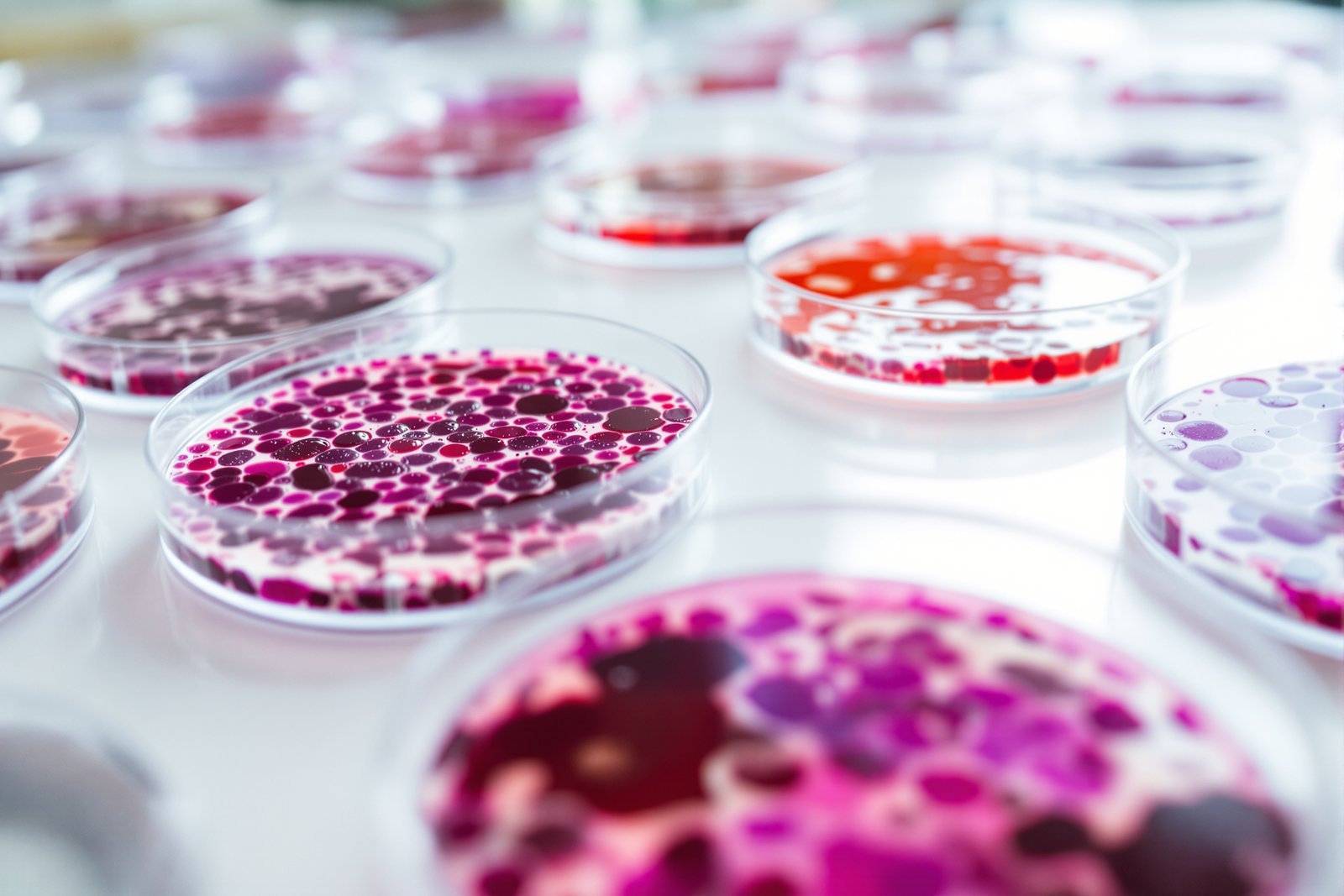
Most bacterial colonies are creamy white or pale yellow. Now and then a plate streaked from soil or water shows colonies that are blood red, violet, orange or deep blue, and each of those colours is a molecule the microbe has gone to the trouble of making.
Why colour at all
A pigment is costly for a cell to make, so its presence usually means it does some job. Microbiologists have proposed many: shielding the cell from strong light, defending it against competing microbes, handling stress, or simply being a by-product of pathways that serve other purposes. In most cases the pigment is a secondary metabolite, a compound not strictly needed for growth, made when conditions call for it rather than all the time. Because such substances are made only under particular conditions, the same strain can look vividly coloured on one medium and almost colourless on another.
For the laboratory, the practical consequence is that pigmentation is a visible readout of what the cell is doing. A change in colour can show at a glance that something in the medium or the environment has altered the organism's metabolism, long before any chemical analysis is run.
A well-known red
The most famous example is the brilliant red pigment made by many strains of the bacterium Serratia marcescens. Wikipedia's article on this red bacterial pigment describes it as a red dye produced by many strains of that organism and by some other Gram-negative bacteria, and notes that it is responsible for the pink tint occasionally found in grime on bathroom porcelain. That pink film, familiar from sinks and tiles, is one of the few places where people meet a bacterial pigment in daily life.
The same article records two details that make the pigment useful to researchers. It is a secondary metabolite of Serratia marcescens, and because it is easy to detect it has been used as a model system for studying secondary metabolism. Its production has long been known to increase when phosphate is limited, and in low-phosphate conditions pigmented strains have been shown to grow to a higher density than unpigmented ones. A colour that responds to the medium and is easy to see is exactly what an experimenter wants when trying to understand how a cell decides to make a product.
The pigment also has an unusual place in history. The article notes that the ability of pigmented strains to grow on bread has been offered as a possible explanation for medieval accounts of bread appearing to bleed, a reminder that red colonies were noticed long before anyone knew what a bacterium was.
Growing coloured colonies
Pigmented microbes are grown the same way as any others: on a culture medium that supplies what they need. Wikipedia's article on the growth medium describes a medium as a solid, liquid or semi-solid designed to support the growth of microorganisms or cells, and notes that the most common media for microorganisms are nutrient broths and agar plates. It also draws a distinction that matters a great deal for pigment work: a defined medium has known quantities of all ingredients, while an undefined medium contains some complex ingredients, such as extracts, whose exact composition is not known.
Because pigment production is sensitive to the medium, researchers studying it often compare several. A defined medium lets them vary one nutrient at a time and watch the colour respond; a rich undefined medium may give more growth but makes it harder to say why. Temperature, light and the length of incubation can matter as well, and some strains lose their colour entirely when grown outside the range they prefer.
From soil to plate
Soil is one of the richest sources of pigmented bacteria. A small amount, shaken in sterile water and spread on agar, will give a crowd of colonies of different shapes and colours. Picking a coloured colony, transferring it to fresh plates until it grows pure, and then identifying it is the classic route by which new pigmented strains are found. From there the questions multiply: what is the pigment, what conditions switch it on, and is it stable enough to be of any use?
A note on safety. Growing microbes from soil means growing organisms whose identity is not yet known, alongside sterilising equipment that uses pressurised steam and very hot liquids. That work belongs in a properly equipped laboratory under trained supervision. This page describes the principles only and is not a procedure to follow.
Why industry is interested
Natural colourants are sought for foods, textiles and materials, and microbes that make them in fermenters could in principle supply them without relying on crops or synthetic chemistry. The obstacles are familiar from other areas of industrial microbiology: yields, stability of the colour in light and heat, and the cost of separating the pigment from the culture. Many studies in this area are early-stage characterisations of a single strain, which is where every such story has to begin.