Breeding rice for salty soils
Salt is present in every soil and every irrigation water. When it builds up faster than rain or drainage can carry it away, land that once grew good crops begins to fail. Rice, the staple food for much of the world, is especially sensitive to it.
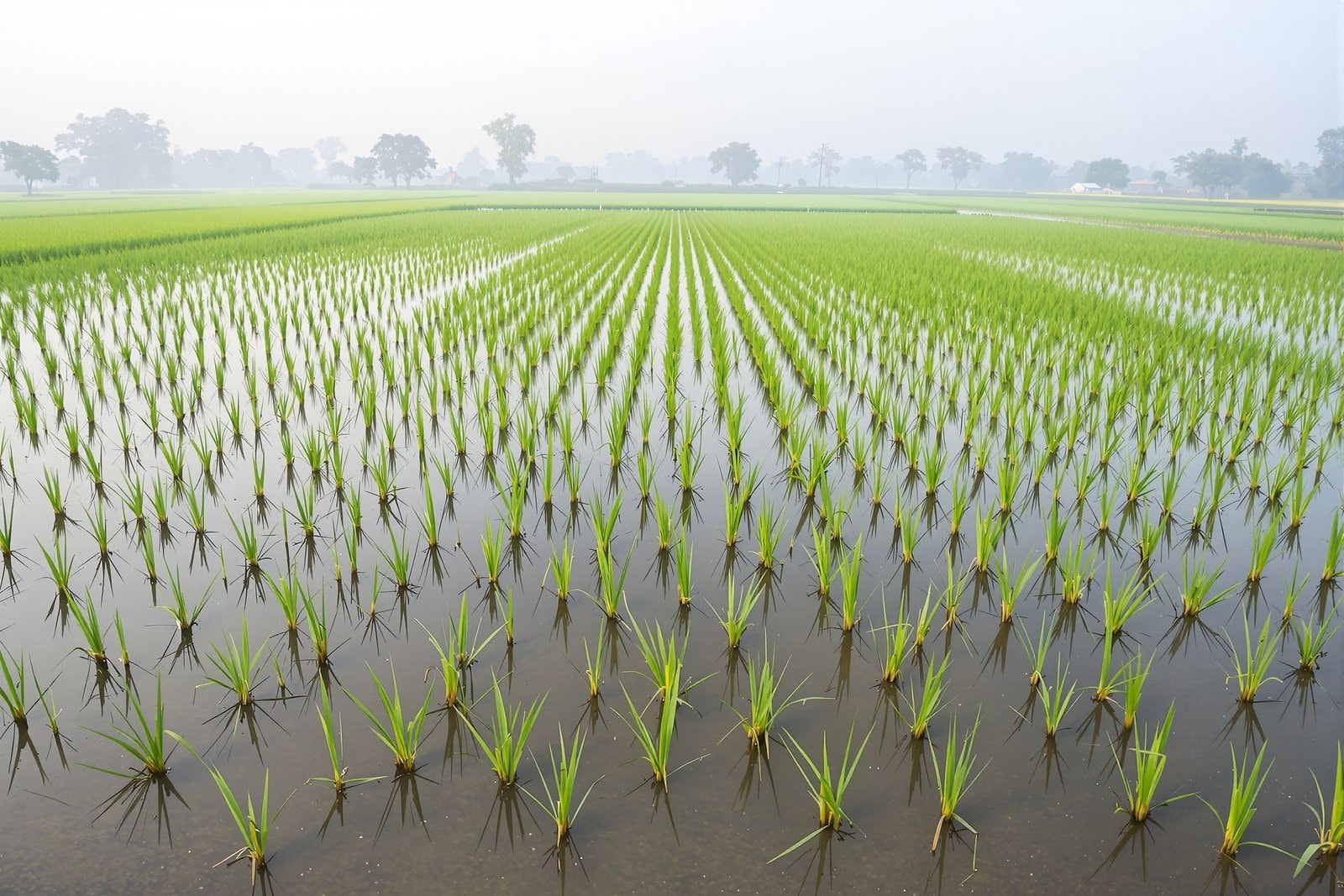
What soil salinity is
Wikipedia's article on soil salinity defines it as the salt content of the soil, and the process of increasing it as salinisation. Salts occur naturally in soils and water; salinisation can be caused by natural processes such as the weathering of minerals or the gradual withdrawal of the sea, and by human activities such as irrigation and road salt. The article names the ions responsible: sodium, potassium, calcium, magnesium and chloride.
Irrigation is the route most relevant to farming. The article explains that almost all water, even natural rainfall, contains some dissolved salts. When plants take up water, the salts stay behind in the soil, and where there is not enough drainage or rain to wash them away they accumulate, sometimes rising to the surface by capillary action. Salinity from irrigation can therefore develop over time wherever irrigation occurs.
What salt does to a crop
Salt affects plants in two broad ways. First, salty soil water holds on to its water more tightly, so roots must work harder to take it up, and a plant can suffer from something like drought even in wet soil. Second, some ions, sodium above all, become harmful when they build up inside plant tissues, interfering with the cell's normal chemistry. Plants respond by closing the pores on their leaves, slowing growth and, if the stress continues, losing leaves and producing less grain.
Rice has a particular reason to be vulnerable. Many of the places it is grown, such as coastal deltas and low-lying land, are exactly where sea water intrudes, and irrigated paddies in dry regions face salt from their own water supply.
How breeders approach tolerance
A 2020 review in the International Journal of Molecular Sciences by Qin and colleagues summarises the state of the field. Its abstract notes that soil salinisation and a degraded ecological environment are challenging agricultural productivity and food security, and that rice is categorised as a salt-susceptible crop. It describes salt tolerance as a complex quantitative trait, one controlled by many genes, each with a modest effect, rather than a single switch. That complexity is the main reason tolerant varieties have been slow to breed.
The same abstract explains that biotechnological efforts to improve salt tolerance depend on a detailed understanding of the molecular mechanisms behind it. The review summarises progress in breeding salt-tolerant rice and in mapping and cloning genes and quantitative trait loci associated with tolerance, and describes biotechnological tools that can be used to cultivate tolerant rice, offering a reference for efforts to develop such varieties more rapidly and precisely.
The breeder's toolkit, in general terms
Conventional breeding for salt tolerance starts by finding plants that already cope better, often traditional varieties or wild relatives from salty coastal land, and crossing them with high-yielding modern varieties. The difficulty is that tolerance, being spread across many genes, is easily diluted in the cross. Molecular markers help here. Once a region of the genome linked to tolerance has been mapped, breeders can check young plants for the presence of that region with a DNA test, rather than waiting to grow each one in salty conditions. This is marker-assisted selection, and it allows a useful stretch of DNA to be carried into a new variety with much less guesswork.
Beyond marker-assisted breeding lie the more direct tools of genetic engineering and genome editing, which the review lists among the approaches available. Whatever the method, the final test is the same: a variety must yield well in real saline fields, not only survive in a laboratory tray.
Managing the land as well as the plant
Breeding is only half of any answer. The soil-salinity article notes that some organisms tolerant to salt and ion toxicity, such as salt-loving plants and salt-tolerant soil bacteria, may offer strategies for improving affected land, and managing drainage and irrigation water remains central. A tolerant variety buys time and yield on affected land; it does not stop the salt from accumulating.
Reading about salt tolerance
Studies in this area usually grow plants at several salt levels and compare how they fare. Two questions help in reading them: at what growth stage was stress applied, since young seedlings and flowering plants can respond very differently, and was the trait measured as survival, as growth, or as grain yield? Only the last is what a farmer finally cares about.