Making protein medicines in cell culture
Some of the most important medicines of the past half century are proteins, large molecules too complex to make by ordinary chemistry. They are made instead by living cells, grown in steel vessels and given the genetic instructions for the protein wanted.
What a protein is
The MedlinePlus Genetics page What are proteins and what do they do? explains that proteins are large, complex molecules that play many critical roles in the body, doing most of the work in cells. They are made of hundreds or thousands of smaller units called amino acids joined in long chains; there are 20 different types of amino acid, and the sequence determines each protein's three-dimensional structure and its function. That sequence is coded in the DNA of a gene.
This last point is the key to making proteins in a factory. If the sequence of a protein is written in a gene, then a cell that carries the gene can be made to build the protein, whether or not that cell would normally make it.
From gene to product
Wikipedia's article on recombinant DNA describes it as DNA formed by laboratory methods of genetic recombination, such as molecular cloning, that bring together genetic material from multiple sources to create sequences that would not otherwise be found in the genome. In practice, the gene for a wanted protein is joined to DNA that allows it to be copied and switched on inside a host cell, and the combined DNA is introduced into that host. The cell then handles the new gene as one of its own and produces the protein it encodes.
Bacteria and yeasts are the simplest hosts, cheap to grow and quick to multiply. But many medically useful proteins need more than a correct chain of amino acids. They must fold into the right shape and often carry sugar groups attached after the chain is made, and simple microbes do not add these in the same way that human cells do.
Why mammalian cells
This is why so many protein medicines are made in mammalian cells. Wikipedia's article on the Chinese hamster ovary cell describes CHO cells as a family of immortalised cell lines derived from the ovary of the Chinese hamster, used widely in biological and medical research and commercially to produce recombinant therapeutic proteins. It notes that they are the most commonly used mammalian hosts for industrial production of recombinant protein therapeutics, valued for rapid growth in suspension culture, high protein production and the ability to produce proteins with mammalian-type glycosylation, the attachment of sugar groups. The article adds that CHO cells have been used to express recombinant proteins particularly since the 1980s.
Growing cells at scale
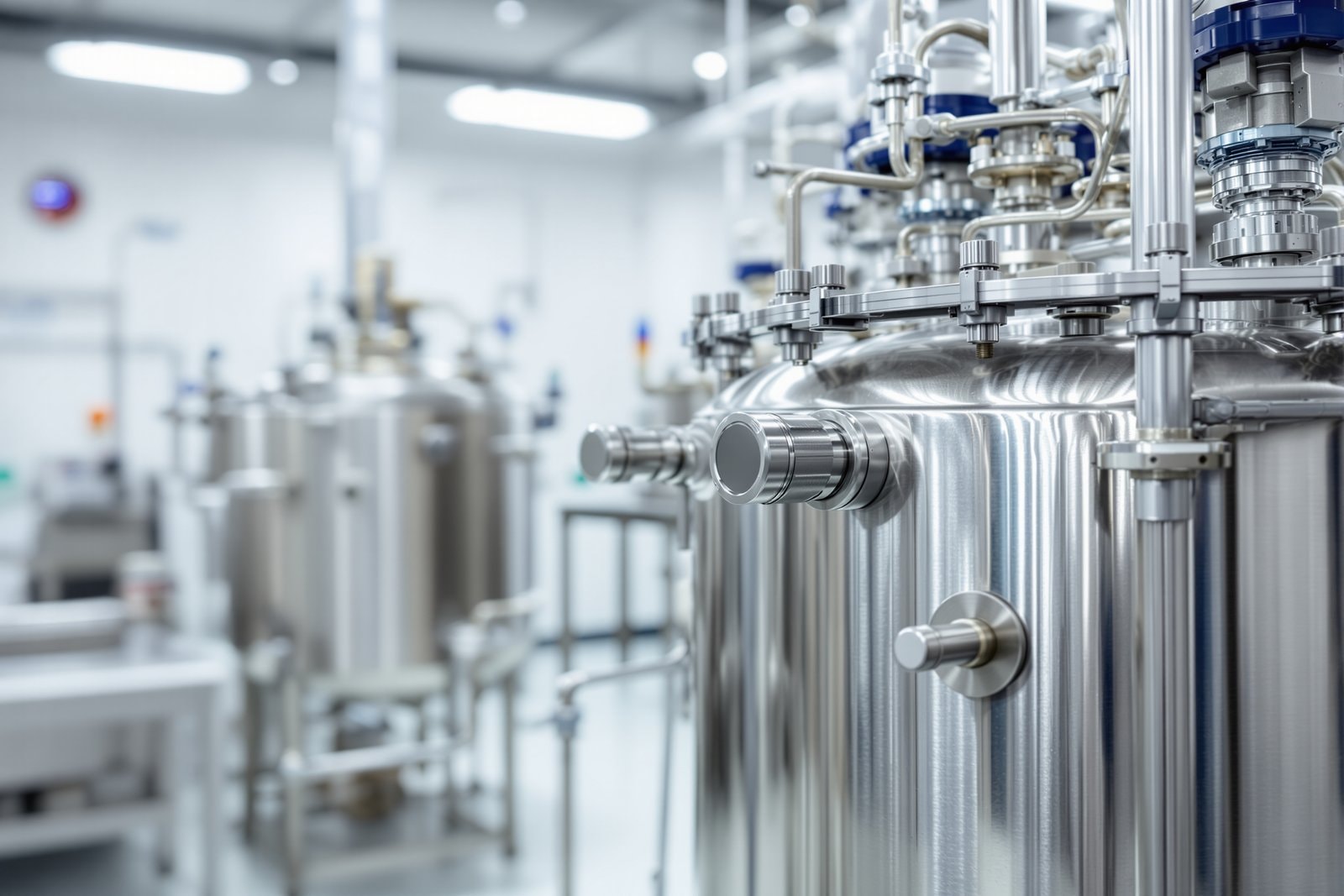
Cells that make a protein must be grown in large numbers, in conditions kept steady for days or weeks. Wikipedia's article on the bioreactor defines it as any manufactured device or system that supports a biologically active environment, commonly cylindrical, ranging from litres to cubic metres, and often made of stainless steel. It explains that bioreactors may be run in batch, fed-batch or continuous mode. Inside, temperature, acidity, dissolved oxygen and nutrients are monitored and adjusted, because mammalian cells are far more demanding than bacteria. When the run ends, the protein must be separated from the cells and the broth and purified, a series of steps that often costs as much effort as growing the cells in the first place.
Biologics as a class
Medicines made this way belong to a wider class. Wikipedia's article on the biopharmaceutical defines a biopharmaceutical, or biologic, as any pharmaceutical product manufactured in, extracted from or semisynthesised from biological sources, and lists among them vaccines, blood components, recombinant therapeutic proteins, monoclonal antibodies and cell therapies. It notes that the term biologics is often used more narrowly to mean biopharmaceuticals produced using recombinant DNA technology.
Insulin, the historic first
The first product of this kind was insulin. Wikipedia's article on insulin as a medication explains that insulin was once made from the pancreas of pigs or cows, and that human versions can be made either by modifying animal insulin or by recombinant technology, using mainly the bacterium E. coli or the yeast Saccharomyces cerevisiae. It records that, beginning in 1982, biosynthetic human insulin has been manufactured for clinical use through recombinant DNA technology. The biopharmaceutical article likewise identifies recombinant human insulin as the first such substance approved for therapeutic use. Insulin is a small protein that microbes can make; many later protein medicines are larger and more complex, which is where mammalian cells took over.
This page describes how such proteins are produced, not how they are used. It makes no claim about any medicine, and nothing here is medical advice.