Microalgae: cleaning wastewater and making fuel
Microalgae are single cells too small to see, yet they run a large share of the planet's photosynthesis. Their appetite for nutrients and their ability to store oil have made them a long-running subject of research in waste treatment and energy.
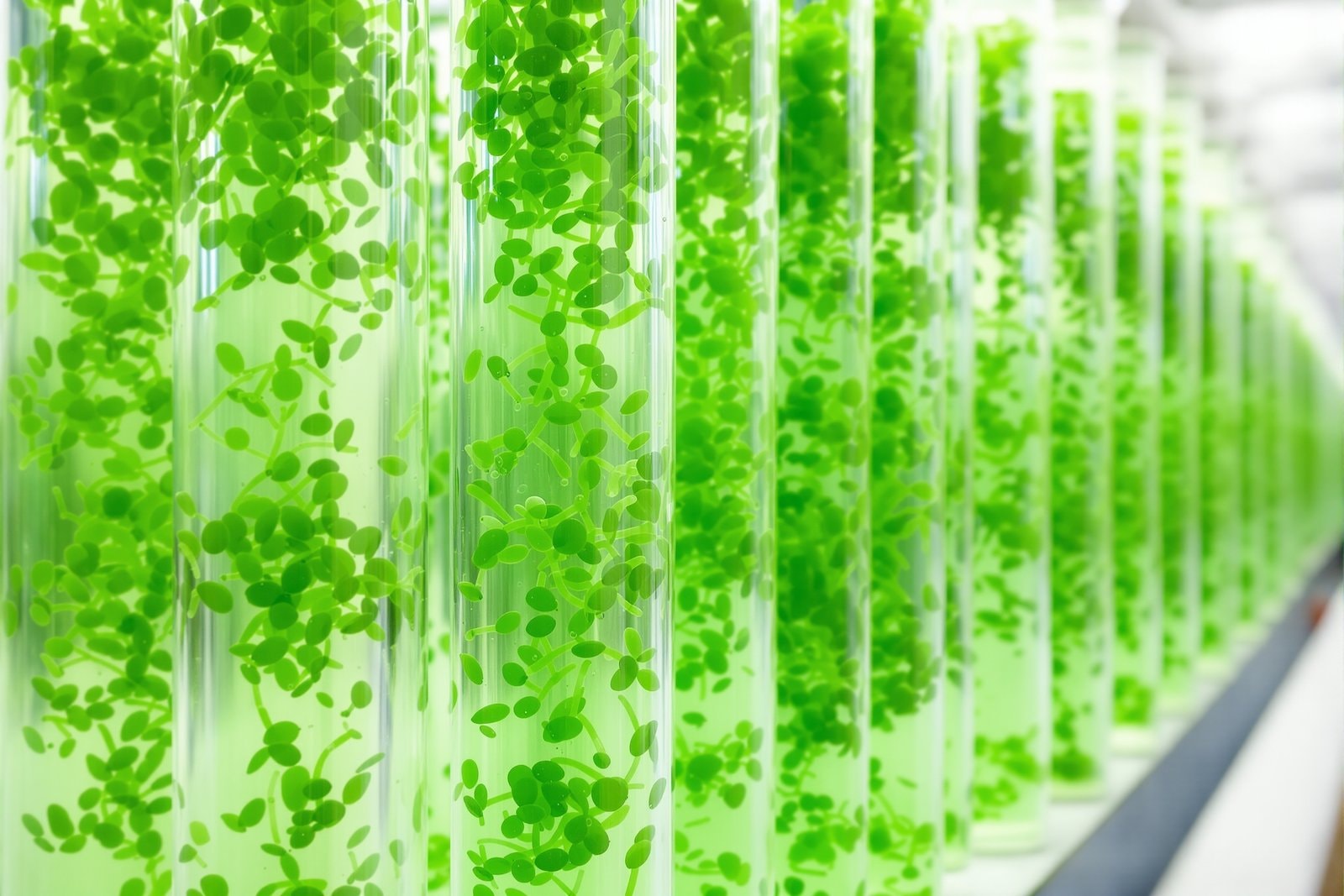
What microalgae are
Wikipedia's article on microalgae describes them as microscopic algae, invisible to the naked eye, living in fresh water and the sea, both in the water column and in sediment. They are single-celled, existing alone or in chains and groups, and depending on the species range in size from a few micrometres to a few hundred. Unlike higher plants they have no roots, stems or leaves. They photosynthesise, and the article notes that they produce approximately half of the atmospheric oxygen and use carbon dioxide to grow. Together with bacteria, they form the base of the aquatic food web.
That combination, fast growth from light, carbon dioxide and dissolved nutrients, is what makes them interesting to biotechnology. A culture of microalgae is in effect a green factory that runs on sunlight and whatever is dissolved in the water around it. The same article notes that they are regarded as a potential feedstock for biofuels and have emerged as a promising organism for bioremediation.
Growing algae on wastewater
Wastewater is rich in exactly the nutrients algae need, nitrogen and phosphorus in particular. The same nutrients cause trouble when they reach rivers and lakes, feeding unwanted blooms. Growing algae deliberately on effluent turns a disposal problem into a growth medium: the algae take up nutrients as they multiply, and the water leaving the system carries less of them. This is one of the examples Wikipedia's article on bioremediation has in mind when it lists microalgae among the biological systems used to remove pollutants from industrial effluents.
The idea is not new. Wikipedia's article on algae fuel recounts that after the Second World War, once the need for alternative transport fuel had faded, algal research turned to culturing algae as a food source and, in some cases, for wastewater treatment. Industrial effluents are harder partners than household sewage: they can be coloured, which blocks light, or contain substances that inhibit growth. Much of the work in this area is therefore about matching strains to particular wastes and finding out what they tolerate.
Fuel from algae
Many microalgae store energy as oils, and oils can in principle be converted into liquid fuels. The algae-fuel article gives the history in outline. In 1942 Harder and Von Witsch were the first to propose growing microalgae as a source of lipids for food or fuel. Interest returned during the oil shocks of the 1970s, and in 1978 the United States Department of Energy began its Aquatic Species Program, which, the article says, ran for 18 years trying to develop a liquid transport fuel competitive with petroleum-derived fuels from algae, largely using open outdoor ponds.
The article is frank about where things stand. It describes algae fuels as an alternative to fossil fuels and to crop-based biofuels such as corn and sugarcane, but says that these fuels have no practical significance and remain an aspirational target in the biofuels research area. That is a useful corrective to the optimism that often surrounds the subject.
Why it is hard
The practical hurdles are easy to list. Open ponds are cheap to build, but as the algae-fuel article notes of the Aquatic Species Program, they are vulnerable to temperature swings and invasion by other organisms. Closed systems such as tubes and panels give more control, but cost more to build and run. Harvesting is another challenge: the cells are tiny and the cultures dilute, so separating them from the water takes energy. Extracting and converting the oil adds further steps. Each of these costs has to be set against the value of the fuel produced, and that balance has been difficult to win.
Combining the two goals, cleaning water and producing biomass, is attractive precisely because it lets one set of costs serve two purposes. If the algae are going to be grown on wastewater anyway, anything useful made from the biomass is a bonus rather than the sole justification. That logic explains why so many studies pair effluent treatment with making some product from the algae.
Reading about algae work
When reading about algal cultivation, three questions help to judge what a study really shows. Was the culture grown on real wastewater or on a laboratory medium made to resemble it? At what scale, a flask, a tank or a pond? And how was the biomass harvested and measured? Results that look impressive at flask scale often behave differently outdoors, where light, temperature and uninvited organisms are all beyond the researcher's control.