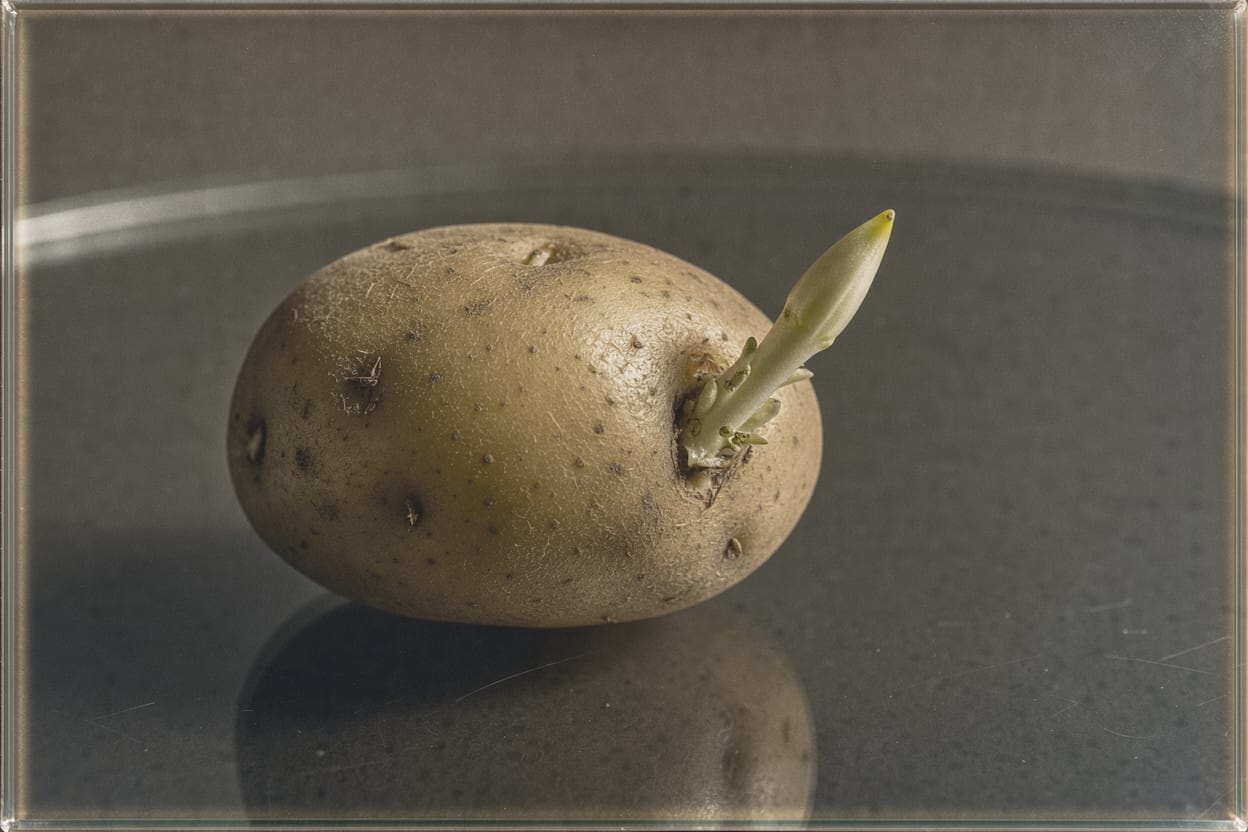
The planting material is a stem
The swollen part of a potato that we eat is a tuber. The eyes on its surface are buds. A tuber saved for planting can grow into a plant of the same variety, preserving the characteristics that made that variety worth keeping. An infection carried in the tuber can also pass into the next crop. Multiplication increases the importance of knowing what the starting material carries.
A meristem is a small region of actively dividing cells. Near a shoot tip it supplies the young stem and leaves. Plant scientists use it as a source of material that can sometimes escape an infection present elsewhere in the parent. They still have to identify and test the stock. A vigorous green shoot is a useful observation, and a laboratory test answers a separate question. Plant tissue and growing points
Three varieties from Bangladesh
Farhana Rumzum Bhuiyan studied Esprit, Lady Rosseta and Meridian. The 2013 report follows them through several distinct comparisons. How much starting tissue survived? How well did the shoots multiply and lengthen? Could the new plantlets make roots?
The varieties agreed on some parts of the process and diverged on others. Esprit and Meridian responded best to the same shoot-growth conditions, while Lady Rosseta favored a different balance. All three formed well-developed root systems under a common rooting condition in the study. Grouping the three under the word “potato” would conceal the difference the comparison brought to light.
Bhuiyan also describes a DAS-ELISA test before larger-scale multiplication. This is an antibody-based test for a particular target in plant material. A result has a scope defined by the target and the sample. The phrase “clean stock” is much easier to interpret when a paper identifies both. Bhuiyan, volume 4, issue 3
Follow the stock forward
- Meristem
- The growing tissue used as a starting point.
- Plantlet
- A young plant with shoots and roots, still small enough to grow in a vessel.
- Seed potato
- A tuber planted to raise the next crop of the variety.
Look for the transition between these units when a paper reports a multiplication rate. A count of shoots in one vessel cannot tell you the yield of marketable tubers in a field. Health checks during multiplication and the performance of the planting stock are later pieces of evidence. The aloe study offers a parallel example in which a high shoot count and survival in soil appear as separate results.